Family floater and individual health insurance represent the two fundamental policy structures for health coverage in India — each appropriate for different household compositions and risk profiles. The right choice between them depends on the number of family members needing coverage, their ages and health conditions, and the mathematical probability of multiple family members needing hospitalisation simultaneously. Understanding the mechanics of each prevents the common mistake of choosing a structure that leaves specific family members inadequately covered.
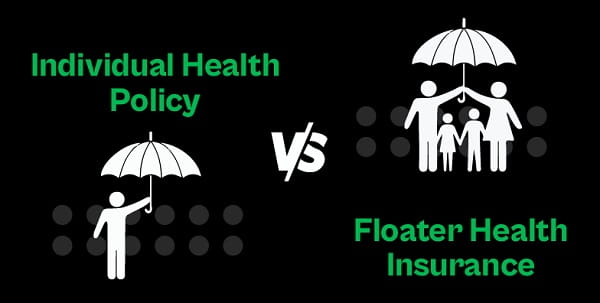
Quick Overview Table — Family Floater vs Individual Health Insurance
| Parameter | Family Floater | Individual Health Insurance |
| Coverage Structure | Single sum insured shared by all members | Separate sum insured per person |
| Number of Members | 2–6 typically (proposer + dependents) | Per individual policy |
| Premium | One combined premium — lower total | Separate premium per person |
| Sum Insured Availability | Entire sum available to any one member | Each member’s sum available only to them |
| Risk of Exhaustion | High if multiple claims in same year | No cross-member risk |
| Best for Young Families | Yes — low simultaneous claim probability | Less economical |
| Best for Senior Members | No — high individual claim probability | Yes — dedicated sum insured |
| NCB Accumulation | Single policy accumulation | Individual policy accumulation |
| Premium Basis | Oldest member’s age drives premium | Each member’s age independently |
| Critical Risk | Entire sum exhausted by single member | Individual adequacy risk |
What is a Family Floater Policy?
A family floater health insurance policy covers multiple family members — typically a couple and their children — under a single policy with a shared sum insured. If the family has a ₹10 lakh floater policy, any family member can utilise any portion of this ₹10 lakh in a given policy year. The premium is calculated primarily based on the oldest covered member’s age — making floater policies attractive when the oldest member is relatively young.
The structural advantage is premium efficiency — a ₹10 lakh floater covering four family members costs significantly less than four individual ₹10 lakh policies. The statistical assumption underpinning this efficiency is that multiple family members are unlikely to require hospitalisation in the same policy year — the insurer prices for this probability.
What is Individual Health Insurance?
Individual health insurance provides each person with their own dedicated sum insured — usable entirely for their own healthcare costs without any sharing with other family members. A family of four each holding individual ₹5 lakh policies has total coverage of ₹20 lakh — with each person’s ₹5 lakh fully dedicated to their individual needs regardless of what other family members claim.
The Critical Floater Risk — Sum Insured Exhaustion
The fundamental structural risk in family floater policies is sum insured exhaustion — if one family member requires expensive treatment consuming the entire floater sum insured, other family members have zero coverage remaining for the rest of the policy year. A ₹10 lakh floater where the father requires cardiac surgery costing ₹9 lakh leaves only ₹1 lakh for the remaining three family members for the rest of the policy year — potentially inadequate for even a straightforward hospitalisation.
This risk is manageable for young families where major single claims are statistically less probable — but becomes genuinely dangerous as family members age and health risks increase.
Age-Based Decision Framework
For families where the oldest member is below 45 — family floaters are typically cost-efficient and the simultaneous high-cost claim risk is manageable. For families including members above 50–55 — individual policies with dedicated sum insureds prevent the single-member claim from depleting coverage for others. For elderly parents — always recommend individual policies, never add them to a young family’s floater where their high-claim probability dramatically increases premium and their hospitalisation could exhaust coverage for the entire family.
A practical solution many financial planners recommend is maintaining a family floater for the young core family unit — couple and young children — with separate individual policies for older family members.
Which is Better — Final Assessment
Neither is universally better — the choice depends on family composition. Young families with children and both parents under 45 benefit most from family floaters through premium efficiency and the low statistical probability of simultaneous major claims. Families with members above 50, pre-existing conditions, or significantly different health risk profiles benefit from individual policies that protect each member’s coverage adequacy independently.
Frequently Asked Questions (FAQs)
Q: Can I add parents to a family floater policy?
A: Technically yes — but this significantly increases premium as the oldest member’s age determines pricing. Separate individual or senior citizen policies for parents are typically more cost-effective and provide better dedicated coverage.
Q: Is a ₹5 lakh family floater enough in India?
A: In 2026’s medical cost environment — generally inadequate for families in metro cities where hospitalisation costs regularly exceed ₹3–₹5 lakh for serious conditions. ₹10 lakh minimum floater or ₹5 lakh individual per member is more appropriate.
Q: What happens when the family floater sum insured is exhausted?
A: No further claims are payable for any covered member until the policy renews. Top-up super top-up policies provide additional coverage above a deductible threshold for exactly this scenario.
Q: Does family floater premium increase if I have children?
A: Adding children typically increases premium marginally — children are low-claim-probability members who add relatively modest premium cost to floater policies.
Q: Can I convert a family floater to individual policies?
A: At renewal, you can restructure coverage. Note that accumulated no-claim bonus and waiting period credits must be managed carefully during restructuring to avoid losing benefits built under the original policy.