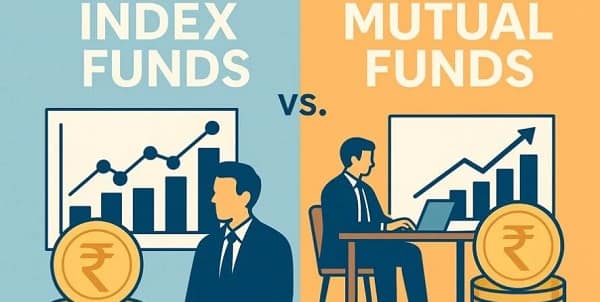
Index funds have captured India’s investment imagination rapidly over the past five years — driven by growing awareness of passive investing philosophy, the consistent underperformance of many active fund managers relative to their benchmarks, and the cost efficiency that passively managed portfolios deliver. But the framing of “index fund vs mutual fund” contains a common misconception worth addressing immediately — index funds are themselves a category of mutual fund. The real comparison is between passive index funds and actively managed mutual funds, each representing a distinct investment philosophy with genuine arguments on both sides.
What is an Index Fund?
An index fund is a passively managed mutual fund that replicates a specific market index — Nifty 50, Sensex, Nifty Next 50, or Nifty Midcap 150 — by holding the same securities in identical proportions as the index. No fund manager makes active stock selection decisions — the portfolio automatically mirrors the index composition. The fund manager’s only role is rebalancing when the index reconstitutes. This passive management structure results in very low expense ratios of 0.1–0.5% annually.
What is an Actively Managed Mutual Fund?
An actively managed mutual fund employs professional fund managers who actively research, select, and manage a portfolio of securities — making buy, sell, and hold decisions based on fundamental analysis, economic outlook, and sector positioning with the explicit goal of generating returns exceeding the benchmark index. Higher research costs and fund manager compensation result in expense ratios of 0.8–2.5% — meaningfully higher than index funds.
Quick Comparison Table — Index Fund vs Actively Managed Mutual Fund
| Parameter | Index Fund | Actively Managed Fund |
| Management Style | Passive — mirrors index | Active — fund manager decisions |
| Expense Ratio | 0.1–0.5% | 0.8–2.5% |
| Returns vs Benchmark | Matches index minus expenses | Aims to beat index — variable success |
| Fund Manager Risk | None — no human decision | Yes — manager quality critical |
| Diversification | Index composition — automatic | Manager-determined |
| Tracking Error | Low | Not applicable |
| Transparency | Very High — index is public | Moderate — monthly portfolio disclosure |
| Best Market Conditions | Bull markets, efficient markets | Volatile, inefficient markets |
| Suitable For | Long-term passive investors | Investors seeking alpha generation |
| Tax Treatment | Same as equity mutual funds | Same as equity mutual funds |
| SIP Available | Yes | Yes |
| Minimum Investment | ₹500 | ₹500 |
The Core Debate — Can Active Managers Beat the Index?
The central question in this comparison is empirical — do actively managed Indian mutual funds consistently outperform index funds after expense ratio costs? The evidence is more nuanced than either side admits.
In India, unlike mature developed markets like the US where passive investing dominance is well-established, active fund managers have demonstrated meaningful ability to outperform benchmarks across mid-cap and small-cap segments where information inefficiency is higher. AMFI data consistently shows that mid-cap and small-cap active managers generate alpha — returns above benchmark — over 10-year horizons at higher rates than their US equivalents.
However, in the large-cap segment — where Nifty 50 and Sensex index funds operate — the evidence increasingly favours passive investing. A majority of large-cap active funds fail to beat their benchmark indices over 10-year periods after accounting for expense ratio costs. The higher a fund’s expense ratio relative to index alternatives, the harder it becomes to overcome the cost drag through active stock picking.
Pros of Index Funds
- Guaranteed Market Returns Minus Minimal Costs Index funds guarantee that investors receive market returns minus a very small expense ratio — typically 0.1–0.3% for major Nifty 50 index funds. No underperformance relative to the market is possible beyond this minimal cost drag. For investors who accept that market returns are sufficient for their wealth creation goals, this guaranteed alignment with market performance is precisely what they want.
- Elimination of Fund Manager Risk Active fund management introduces the risk that the fund manager makes poor decisions, departs for another firm, or runs a concentrated portfolio that suffers disproportionately from individual company failures. Index funds carry no fund manager risk — the portfolio is determined by index rules rather than human judgment.
- Cost Compounding Advantage The 0.5–2% expense ratio advantage of index funds over active funds compounds significantly over 15–20 year investment horizons. On ₹50 lakh invested for 20 years, 1% annual cost advantage translates to approximately ₹20–₹25 lakh additional corpus — a compelling mathematical argument for cost minimisation.
- Exceptional Transparency Nifty 50 constituents are publicly known — index fund investors always know exactly which companies their money is invested in and in what proportions. This transparency is significantly higher than actively managed funds where portfolio composition is disclosed monthly.
Cons of Index Funds
- No Ability to Outperform — Capped at Market Returns Index funds definitionally cannot outperform the market — they deliver market returns minus expenses. Investors seeking superior returns through talented active management forgo this possibility entirely. In a rising market where skilled active managers identify multibaggers ahead of index inclusion, index fund investors miss these exceptional returns.
- Automatic Inclusion of Overvalued or Deteriorating Companies Index funds must hold all index constituents regardless of their individual valuation or business quality. When an overvalued company enters the Nifty 50, index funds must purchase it at full market price — with no ability to avoid obvious value traps that active managers can sidestep through research.
Pros of Actively Managed Mutual Funds
- Alpha Generation Potential in Mid and Small Cap Skilled active managers in India’s mid-cap and small-cap segments have demonstrated genuine ability to identify companies before they achieve wide market recognition — generating returns significantly above benchmark indices. For investors with appropriate risk tolerance and long horizons, this alpha potential represents genuine additional wealth creation.
- Downside Protection During Corrections Active managers can reduce equity exposure, increase cash holdings, or shift toward defensive sectors during anticipated market downturns — providing partial downside protection that rigid index funds cannot implement.
Cons of Actively Managed Mutual Funds
- Most Active Large-Cap Funds Underperform Index Over Time The mathematics of consistent benchmark outperformance after fees is genuinely difficult — and Indian large-cap active fund data increasingly confirms that most active managers fail to justify their expense ratio premium over 10+ year periods.
- Fund Manager Dependency Active fund performance is often attributable to specific fund managers whose departure creates performance uncertainty that index fund investors never face.
Which is Better — Final Assessment
For large-cap equity exposure — Nifty 50 and Sensex index funds are clearly better for most investors. The evidence that active large-cap managers consistently outperform after costs is weak, and the guaranteed market return at minimal expense ratio provides a compelling proposition.
For mid-cap and small-cap allocation — actively managed funds from consistently performing AMCs with strong research teams have demonstrated genuine alpha generation that justifies their higher expense ratios. The information inefficiency in India’s smaller company space gives skilled active managers real edge.
The optimal portfolio combines both — large-cap index funds for the core, low-cost equity market exposure, plus select mid-cap and small-cap active funds from established fund houses for alpha-seeking allocation.
Frequently Asked Questions (FAQs)
Q: Are index funds better than actively managed mutual funds in India?
A: For large-cap exposure — generally yes. For mid-cap and small-cap — active funds with strong track records still add value. The answer depends on market segment.
Q: Do index funds provide enough returns for retirement planning?
A: Yes — Nifty 50 index funds have delivered approximately 12–13% CAGR over 15+ years, sufficient for robust long-term retirement corpus building.
Q: What is tracking error and why does it matter for index funds?
A: Tracking error measures how closely an index fund’s returns match its benchmark index. Lower tracking error means better index replication — choose index funds with tracking error below 0.10%.
Q: Can index funds lose money?
A: Yes — index funds reflect market performance including downturns. They lose value when the overall market declines, though they always match the index rather than underperforming it.
Q: Which index fund is best for beginners in India?
A: Nifty 50 and Sensex index funds from UTI, HDFC, or SBI are ideal for beginners — low expense ratios, maximum diversification across India’s largest companies, and long performance track records.